> For the complete documentation index, see [llms.txt](https://docs.revrobotics.com/llms.txt). Markdown versions of documentation pages are available by appending `.md` to page URLs; this page is available as [Markdown](https://docs.revrobotics.com/rev-crossover-products/sensors/touch-sensor/specs.md).
# Specifications
### General Specifications
| **Parameter** | **Value and Units** |
| ------------- | ------------------- |
| Sensor Type | Digital, Active-low |
| Signal | n+1 |
### Electrical Specifications
Parameter
Min
Typ
Max
Units
Parameter
Min
Typ
Max
Units
Operating Voltage Range
-
-
3.3
V
### Output States
| **Button** | **n+1 Voltage** | **LED State** | **FTC SDK Logic** |
| ----------- | --------------- | ------------- | ----------------- |
| Not Pressed | 3.3V | Off | TRUE |
| Pressed | 0V | On | FALSE |
{% hint style="warning" %}
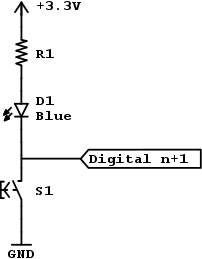
The button is directly in-line with the LED and signal. So if the light is operating correctly, the button is working.
{% endhint %}
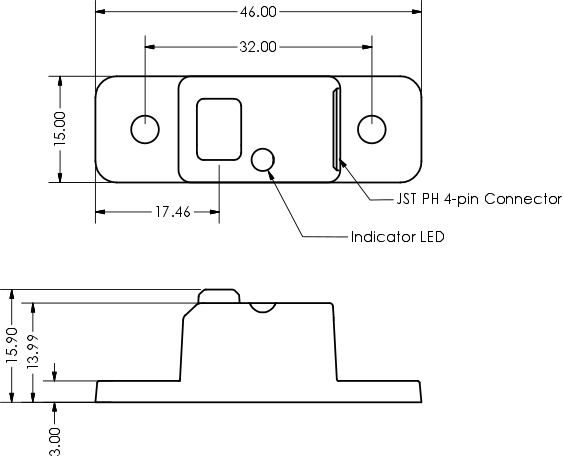
## Mechanical Drawings
## Pinout and Schematic
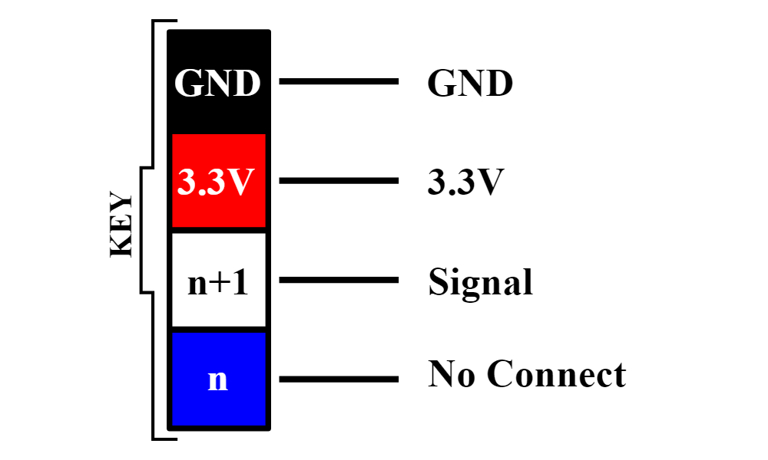
In the image below, is the key for the wired connection between the touch sensor and the robot controller. The touch sensor does not use or pick up a signal from the **n** (blue) wire. This is not a problem if there is one digital sensor per port. However, If you intend to connect more than one digital sensor to the same port using the sensor splitter cable, make sure that the **n+1** (white) wire portion of the splitter cable is plugged into the touch sensor.